
How to Check Watertown Criminal History
Begin with the office that made the Watertown record. A police narrative and a court disposition are separate products. The first explains an officer's response and initial allegations. The second shows what was filed and how the case ended. If the event led to detention, county custody sources add booking or release status, but they do not replace either city file.
- Identify whether Watertown Police, another agency, or a court created the record.
- Ask WPD Records for the police or accident report by email or in person.
- Search WebCriminal for a pending city case, then confirm details with Watertown City Court.
- Use the Jefferson County jail and VINE route for custody, or County Court after a felony indictment.
- For your own statewide fingerprint history, request a DCJS Record Review through IdentoGO.
The public cannot order another person's DCJS rap sheet. A statewide public court-name result instead comes from OCA CHRS, which is not fingerprint matched. At Watertown altitude, those state tools are fallbacks. The police report and City Court file give the most direct local evidence.
Inside Watertown Police Records
The Watertown Police Records Section explains the city's request route and restrictions. Its records window is on the second floor of the Public Safety Building at 751 Waterman Drive. It is open weekdays from 9:00 a.m. to 3:45 p.m. Records staff can be reached at 315-786-2637 or 315-786-2640 and at policerecords@watertown-ny.gov.
The official screen from WPD Records reflects Watertown's direct city channel.
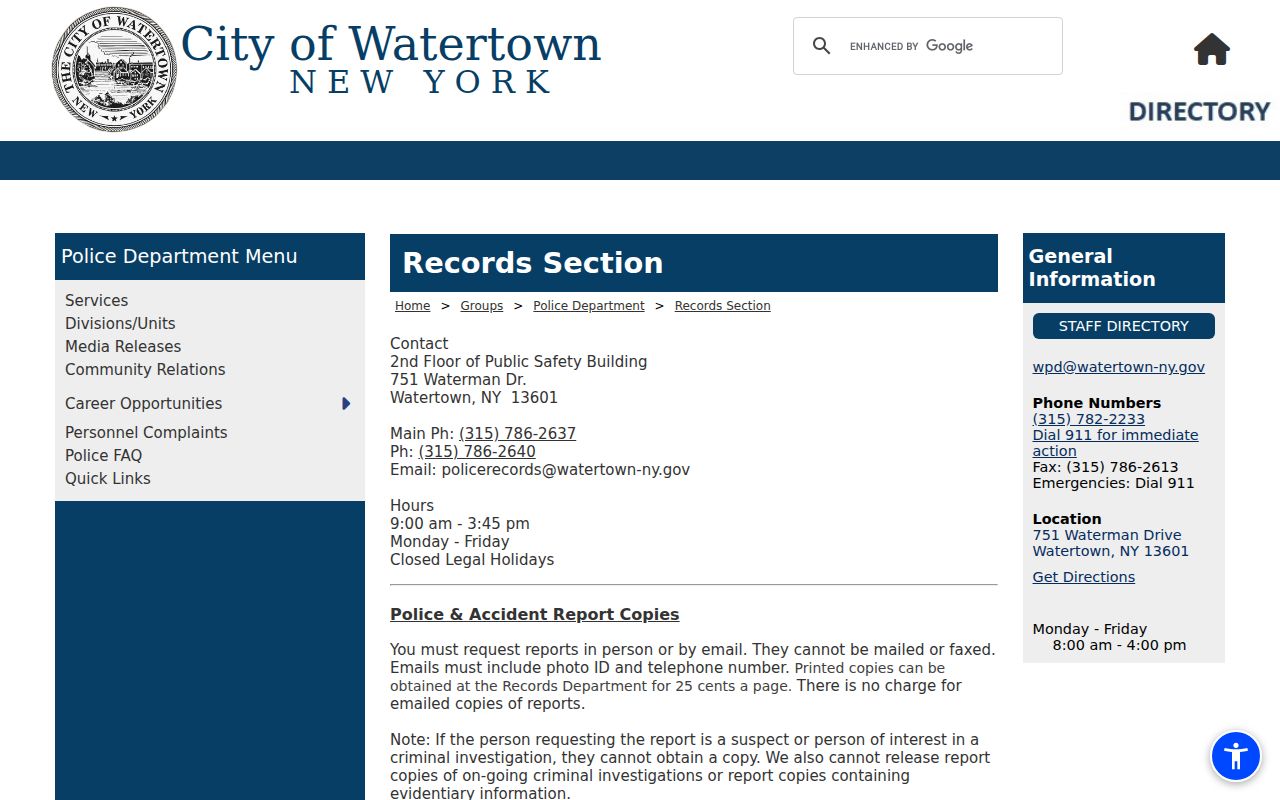
That city source matters because Jefferson County FOIL does not transfer custody of a WPD file. Ask the department that created it, and include enough facts for staff to locate one incident.
WPD Records Section
751 Waterman Drive
Watertown, NY 13601
315-786-2637 / 2640
Weekdays, 9:00 a.m.-3:45 p.m.
The Watertown Police Department
WPD accepts report requests in person or by email. It does not send reports by mail or fax under the posted procedure. An email request needs a copy of photo identification and a callback phone number. Add the report or incident number if known. If it is not known, give the date, place, and type of event, then state which report or portion is requested.
The Watertown Police Department creates incident, arrest, and accident records for events within city jurisdiction. A report may state the time and place, responding officers, reported conduct, property or evidence, and initial arrest charge. Public copies can omit protected identifiers, victim information, investigative details, and safety-sensitive content. That is a lawful redaction, not proof that the report never contained the material.
WPD's policy excludes ongoing or evidentiary reports and requests from suspects or people of interest. A person placed in one of those categories should not try to bypass the restriction through a broad FOIL demand. Counsel or the pending-case disclosure process may be the correct route.
Different Watertown police products also call for different descriptions. Ask for the incident report when the agency response is central. Ask separately for photographs, body-worn-camera video, 911 audio, or dispatch data because each item can have its own retention, review, and redaction path. An accident report may also be available through the official New York DMV accident-record process. Naming the exact item keeps a request from becoming an open-ended search.
Watertown Report Copy Options
Delivery format changes both cost and method. An emailed WPD report is free. Paper copies cost $0.25 per page. The records window also offers a $10 cash local records or background check with photo identification. That local Watertown product is not a fingerprint-based New York rap sheet and should not be described as one.
| Watertown item | Method | Posted cost |
|---|---|---|
| Emailed police report | Email request with photo ID and phone | Free |
| Paper police report | Records window | $0.25 per page |
| Local records check | Records window with photo ID | $10 cash |
Civilian fingerprint cards are no longer made by WPD. A person reviewing their own statewide New York record must use the IdentoGO/DCJS process. Keeping the two products distinct prevents a local no-result from being treated as a statewide finding.
Arrests and Bookings in Watertown
A Watertown arrest begins with city police paperwork, but detention does not remain in a long-term city locator. People held after arrest are routed to Jefferson County Correctional Facility at the Waterman Drive public-safety complex. The county did not publish a searchable inmate roster during the research review. Current custody is therefore checked through the jail's official contact route and VINELink New York.
A no-result needs care. The person may have been released, transferred, entered under different spelling, or not yet reflected in a service. Check the arraignment court next. Watertown City Court may show the local case through WebCriminal, while an indicted felony later moves to Jefferson County Court. State-sentenced custody eventually belongs in DOCCS Incarcerated Lookup, not the city police record system.
Note: A Watertown booking shows custody and allegations; it does not prove that any charge resulted in conviction.
Watertown Arrest Record Route
The physical route is compact, but record custody stays split. WPD and county corrections are close on Waterman Drive. Watertown City Court sits at City Hall on Washington Street. An arresting officer creates the report, corrections creates the booking file, and the court creates the arraignment and docket. Those files can show different charge language because prosecutors and courts may change or dismiss the arrest allegation.
Local sequence: WPD incident and arrest report › Jefferson County booking, if detained › Watertown City Court arraignment › Jefferson County Court, if indicted.
Use the sequence as a check list. For a recent event, start at WPD and the custody channel. For a filed case, use the court. For the final outcome, ask the sentencing court for a certificate of disposition, a clerk-certified statement of how the case ended.
Watertown Municipal Court Records
Watertown City Court is at City Hall, 245 Washington Street. It hears city misdemeanors, violations, traffic and local offenses, plus arraignments and preliminary felony matters. Search the statewide WebCriminal portal for pending cases and future appearances. Then call or visit the court clerk to verify the docket and request the actual public paper.
| Court | Watertown City Court at 245 Washington Street. |
|---|---|
| Local Case Types | Misdemeanors, violations, traffic and city offenses, arraignments, and felony preliminary work. |
| Lookup | WebCriminal for pending data, followed by the City Court clerk. |
| Public Fields | Docket number, charges, appearances, status, attorney, disposition, and sentence when public. |
| Certified Outcome | Request a certificate of disposition from the court that resolved the case. |
WebCriminal is informational. A missing result can reflect spelling, the wrong court, sealing, a paper record, or timing. The clerk's record controls. Grand-jury minutes, sealed cases, youthful-offender records, victim data, and protected identifiers are not ordinary public docket material.
Accessing Watertown Court Records
The court's accessible public entrance is on Sterling Street and has push-button access. Public parking is available on or next to the site. Raise interpreter or accommodation needs with the clerk before an appearance. These details help a requestor reach the correct city counter rather than assuming the County Clerk keeps every local file.
A felony can start in Watertown City Court and then transfer after indictment. Early accusatory papers may therefore remain part of the local path, while the superior-court file sits with Jefferson County Court and County Clerk. The Jefferson County criminal court case record route gives the county-level process without duplicating it here.
Where Watertown Records End Up
Watertown criminal records do not merge into one file. WPD reports stay with city police. Jail intake stays with Jefferson County corrections. City Court maintains its docket. A felony court file moves to the superior-court custodian after indictment, while reportable arrest cycles and dispositions flow to DCJS.
Record flow: Watertown Police Department › Watertown City Court or Jefferson County Court › New York State Division of Criminal Justice Services.
DCJS is the sole source of an official New York criminal-history record, and that fingerprint-based Record Review is subject-only. CHRS is a separate paid public name search of on-file court records. Neither one replaces the city report or a certified disposition from Watertown City Court.
Reading Watertown Crime Records
Watertown had 24,685 residents in the 2020 Census and serves as the Jefferson County seat and center of the Watertown-Fort Drum area. The WPD 2024 Annual Report provides local calls, arrests, and offense measures. Those categories should not be blended. Calls for service count requests or responses, index crimes count defined reported offenses, and arrests count enforcement events.
None of those measures equals convictions or unique people. A year-to-year change can also reflect reporting rules and agency practices. Use the annual report for its stated category, then use the court record to learn what happened in one case.
Fort Drum adds another routing question. An event on the federal military installation may begin with military or federal law enforcement, while an off-post Watertown event usually begins with WPD. If a report cannot be found at the city records window, verify the exact location and arresting agency before concluding that no record exists. A local transfer to county jail or court does not make WPD custodian of the installation's original report.
Public Access Rules
Watertown Police is an executive agency for New York Freedom of Information Law purposes. FOIL permits access to agency records but also allows redaction or denial for active investigations, privacy, victim safety, juvenile matters, and other protected interests. Court records follow Judiciary Law and court rules instead of city FOIL. Send each request to the custodian, with a narrow description and preferred format.
Key statutes:
Public Officers Law Article 6 governs FOIL requests to Watertown agencies and allows statutory exemptions.
Judiciary Law §255 governs lawful clerk searches and certifications.
CPL 160.50 seals records when a criminal action ends in the accused's favor, subject to exceptions.
Ask for identifiable records rather than an explanation or a new report. Include dates, locations, report or docket numbers, and the exact portions sought. If an agency denies access, its response should identify the basis and available appeal route.
Restricted Watertown Police Records
WPD's posted policy restricts reports tied to ongoing investigations, evidentiary material, and requests from a suspect or person of interest. That status changes the route, not the underlying need for accurate records. A person facing a pending city case should use counsel and the criminal discovery process for case material rather than treating the public records window as a substitute.
For a closed matter, the court disposition may answer what the police report cannot. If the case ended favorably, sealing rules may further limit public access. Keep any WPD denial, identify the court and docket, and ask the clerk for the public disposition or a certified copy when permitted. Compare the charge, outcome, sentence, and date rather than relying on a matching name alone.